Last night, as we were falling asleep, the room began to vibrate. Then it juttered. We followed our new emergency plan: rolling off the bed and pulling the mattress over us. After several seconds of juttering, the swaying began. The room--actually the whole northeastern region of Japan--swayed for about a minute.
When we got off the floor, the power was out. Kelli and our neighbor went to check on some friends. I filled our tub with water, filled water bottles, and turned off the gas.
We lost power for about 19 hours. We didn't lose water, but parts of our town did. This aftershock damaged our area much more than the main quake. The bridges that suddenly had large bumps on either side after the big earthquake now had broken pavement on either end. Part of the main highway collapsed with the hillside a few miles from our home. The roads in some neighborhoods cracked open. Some bridges are closed.
This aftershock worried us more too. Will there be a tsunami? Will Fukushima Daiichi get swamped or cracked? If it did, how long will it take for the radiation to blow our direction? There was no way of knowing without electricity.
After unwinding, we flopped our mattress back onto the bed and then we flopped onto the mattress. Today we carried on as if everything was normal, except the power outage. We taught classes and went to meetings.
When the power came on, we watched the news.
over 4 million homes are without power. In Sendai, many homes got their gas reconnected two days ago, only to lose it again. Many homes got water back yesterday, only to lose it again when the pumps lost power last night. Just as things were coming back for many people, they were stolen away again.
Hokkaido, the large northern island was supplying a lot of electricity to our region via an undersea cable. The cable lost power and they still don't know why.
Fishermen in Ishinomaki were discussing what to do with the thousands of pounds of fish that had been ready to vacuum package before the quake a month ago. The fishermen will be payed to take the rotten fish 90km off the coast and dump it into the sea.
One woman in here 70s died from the aftershock yesterday when the blackout shut off her ventilator. There was an oxygen bottle for emergency use in her room, but there was no sign that anyone had tried to use it.
The most shocking news was that many hospitals have few or no full time doctors. Many doctors abandoned their posts and their patients after the quake.
Some doctors are trying to help those hospitals by visiting on a rotating basis from their home hospitals. One badly damaged hospital in Kesennuma is being run by the nurses, who refused to leave the patients. The number cards for patients waiting for help are hand-written on cardboard. The first floor was flooded by the tsunami, destroying CAT scanners, x-ray machines, and the computers with patient files. The old paper files were caked with mud. The hospital still doesn't have water. Each day a delivery truck fills lined trash cans with water and the nurses carry them upstairs. They are exhausted, physically and mentally, but they haven't quit. And more patients keep coming.
And that was the news.
Things aren't good. Sure, our area seems fine, but people all around us are suffering. I've met people who lost neighbors and houses. People are working hard and getting tired.
Just as you begin to feel comfortable again, the aftershocks start back up. The USGS summary of aftershocks isn't very encouraging. There are statistical patterns to aftershocks, but each quake and it's aftershocks are random. All you can do is stay prepared and wait.
One preparation we can tackle is to get all the required tools and clothing to volunteer. We'll get steel lined boots and water-proof gear and get ready to go. We want to help.
Friday, April 8, 2011

Wednesday, March 16, 2011
Gas
I've waited in line for gas for three days, and I still haven't gotten any gas. The main supply route--both trains and trucks--ran through Sendai. All shipments to our area have been re-routed up the west coast through Akita and over the mountains. The best mountain roads run into Morioka. South of Morioka all of the mountain roads running to the west coast are narrow, often only one lane. I would NOT want to drive a semi over one of those puppies.
Everyday some grocery stores are opened. Everyday maybe one or two gas stations get fuel. People wait in lines for hours for ten or twenty liters. I've waited in line for three days. The first day I was unprepared. I didn't take water or a book. The line was over a mile and a half long. I waited an hour and moved less than 100 yards. I gave up.
On day two, I took coffee, a snack, and a book. I was about a quarter mile from the station when I pulled up at 6:40am, well before the station should open. The line crept forward...far too slowly. Then a man walked by with his arms in an "X." No gas.
Today, I got in the wrong line. No gas.
We are so lucky. Some people I know only got power back yesterday. Many people still don't have power or water. Many people don't have homes. Many people lost their families. We're some of the fortunate ones. We have food, gas to cook with, and water to drink. Kerosene for heaters is harder to come by, but we have coats and wool socks.
Many people are panicked. Several foreigners I know have broken contract and left with less than a day's notice. People in the the US are getting information filtered through the media. All you see is a burning nuclear reactor and the devastated coastal towns. A few miles inland and the damage isn't so bad. A nearby town was hit fairly hard. A lot of the older buildings were damaged, but I haven't heard of anyone being hurt or killed. If you have family in the area, please don't panic. Ask them for an honest assessment of their situation. As little as ten miles can make a huge impact on the situation someone is in here. Keep calm, encourage your family and don't listen to CNN. Go to BBC or NHK World or Japan Today. Japan Today is up and down (I think their servers might be getting hit by rolling blackouts in Tokyo).
Our town had a few broken windows, but I didn't hear any reports of fires or collapsed buildings. Now we just have to ride out the shortages and keep an eye on Fukushima.
With so little gas, there is very little traffic. It begins to feel eerie. Many students don't come to school because their parents don't have gas. Pretty soon, a whole bunch of Toyotas and Mazdas are going to be very fancy pieces of sculpture.
It's hard to believe how much our modern world relies on gas. Without gas for trucks, grocery stores are closed. Without gas, workers can't get to work, so stores don't open. Gas really is a corner stone of our economy.
Please don't worry about us. Our area is relatively okay. We're far enough away from Fukushima that a meltdown isn't really an imminent threat.
I'm going to write a post soon about what I think is important for preparation before this sort of thing happens. Stay tuned and thanks for keeping us in our thoughts and prayers. So far, we're doing fine.
Everyday some grocery stores are opened. Everyday maybe one or two gas stations get fuel. People wait in lines for hours for ten or twenty liters. I've waited in line for three days. The first day I was unprepared. I didn't take water or a book. The line was over a mile and a half long. I waited an hour and moved less than 100 yards. I gave up.
On day two, I took coffee, a snack, and a book. I was about a quarter mile from the station when I pulled up at 6:40am, well before the station should open. The line crept forward...far too slowly. Then a man walked by with his arms in an "X." No gas.
Today, I got in the wrong line. No gas.
We are so lucky. Some people I know only got power back yesterday. Many people still don't have power or water. Many people don't have homes. Many people lost their families. We're some of the fortunate ones. We have food, gas to cook with, and water to drink. Kerosene for heaters is harder to come by, but we have coats and wool socks.
Many people are panicked. Several foreigners I know have broken contract and left with less than a day's notice. People in the the US are getting information filtered through the media. All you see is a burning nuclear reactor and the devastated coastal towns. A few miles inland and the damage isn't so bad. A nearby town was hit fairly hard. A lot of the older buildings were damaged, but I haven't heard of anyone being hurt or killed. If you have family in the area, please don't panic. Ask them for an honest assessment of their situation. As little as ten miles can make a huge impact on the situation someone is in here. Keep calm, encourage your family and don't listen to CNN. Go to BBC or NHK World or Japan Today. Japan Today is up and down (I think their servers might be getting hit by rolling blackouts in Tokyo).
Our town had a few broken windows, but I didn't hear any reports of fires or collapsed buildings. Now we just have to ride out the shortages and keep an eye on Fukushima.
With so little gas, there is very little traffic. It begins to feel eerie. Many students don't come to school because their parents don't have gas. Pretty soon, a whole bunch of Toyotas and Mazdas are going to be very fancy pieces of sculpture.
It's hard to believe how much our modern world relies on gas. Without gas for trucks, grocery stores are closed. Without gas, workers can't get to work, so stores don't open. Gas really is a corner stone of our economy.
Please don't worry about us. Our area is relatively okay. We're far enough away from Fukushima that a meltdown isn't really an imminent threat.
I'm going to write a post soon about what I think is important for preparation before this sort of thing happens. Stay tuned and thanks for keeping us in our thoughts and prayers. So far, we're doing fine.
Saturday, March 12, 2011
The Earthquake
Hey, everyone. We're okay. It's 3:15 now, so don't consider this a news update.
Our area wasn't as hard hit as places as little as 20km south. As soon as the quake hit, the power was out, so we didn't even know how bad things were. Late Saturday night we saw newspaper pictures from the coast...
I'm sure to many of you, the names of Ofunato, Hachinohe, and others are just images or news videos of places with names that are hard to pronounce. To us, those are places we've been, the homes of teachers' families. I've fished in Ofunato. The videos you see of a harbor surrounded by rubble are places I've driven through.
The video of Sendai airport's runway being flooded by a tsunami might seem terrible to see, but we landed on that runway.
In the time it has taken to write these few sentences, we've felt two more aftershocks, 48 hours after the first quake. We have power and internet. We never lost water. Meanwhile, entire towns were being swept away.
Nuclear power plants are damaged and in danger of melting down. Another strong aftershock could hit any time. Right now life is a strange balance of routine and troubling potential. We went to the grocery store to stock up on food in case we need it. Part of me was interested to see what people had bought (there was no instant ramen or soup mix, but lots of cookies and chips were still on the shelves). Iin the grocery store, ceiling tiles and a few lights had fallen. The lady asked us if we had our point card.
I'm not sure what to write right now, and I'm pretty distracted, so I won't ramble.
If you are wondering how you can help, I would ask you to think of all the major disasters in the past decade. This level of disaster doesn't get better with a one time donation or visit. As you see what is happening in Japan, don't forget Haiti and Indonesia, where the government wasn't as well prepared. There economies--and much more importantly--their people still need help. Don't forget them.
As far as helping Japan, I have no idea. I've seen Red Cross vehicles on the roads, so if you contact the American Red Cross, maybe they can help direct you.
Thank you for the concern and the prayers.
Our area wasn't as hard hit as places as little as 20km south. As soon as the quake hit, the power was out, so we didn't even know how bad things were. Late Saturday night we saw newspaper pictures from the coast...
I'm sure to many of you, the names of Ofunato, Hachinohe, and others are just images or news videos of places with names that are hard to pronounce. To us, those are places we've been, the homes of teachers' families. I've fished in Ofunato. The videos you see of a harbor surrounded by rubble are places I've driven through.
The video of Sendai airport's runway being flooded by a tsunami might seem terrible to see, but we landed on that runway.
In the time it has taken to write these few sentences, we've felt two more aftershocks, 48 hours after the first quake. We have power and internet. We never lost water. Meanwhile, entire towns were being swept away.
Nuclear power plants are damaged and in danger of melting down. Another strong aftershock could hit any time. Right now life is a strange balance of routine and troubling potential. We went to the grocery store to stock up on food in case we need it. Part of me was interested to see what people had bought (there was no instant ramen or soup mix, but lots of cookies and chips were still on the shelves). Iin the grocery store, ceiling tiles and a few lights had fallen. The lady asked us if we had our point card.
I'm not sure what to write right now, and I'm pretty distracted, so I won't ramble.
If you are wondering how you can help, I would ask you to think of all the major disasters in the past decade. This level of disaster doesn't get better with a one time donation or visit. As you see what is happening in Japan, don't forget Haiti and Indonesia, where the government wasn't as well prepared. There economies--and much more importantly--their people still need help. Don't forget them.
As far as helping Japan, I have no idea. I've seen Red Cross vehicles on the roads, so if you contact the American Red Cross, maybe they can help direct you.
Thank you for the concern and the prayers.
Friday, January 14, 2011
Kyoto: Heian Shrine
Heian Shrine was one of the most impressive temple complexes that we visited and we almost missed it! It wasn't even on our radar, but there was a martial arts supply store that I wanted to visit, and the nearest landmark to tell to the taxi driver was Heian. Boy, did we luck out.


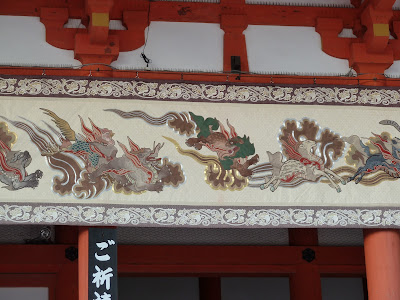


Notice the wire to keep birds out.


This large courtyard is completely surrounded by buildings.

This lion fountain was to the left after entering the main gate.

And the dragon was to the right.


Look at the embroidery on the banner. The banner was about 18 inches wide by 30 yards long.

This giant torii gate stood outside the main gate. About a quarter of a mile on the other side is where we celebrated New Year's Eve.
The temple also had a very large and famous garden, but we didn't go in because it was fairly expensive, we were cold, and we wanted to see (ok, maybe just I did) the samurai stuff.
I didn't take pictures but the swords were awesome. There is a martial art called Iaido which uses swords as part of a physical exercise. Those swords were made out of aluminum because real swords have to be registered as deadly weapons. The store had some old, historical blades that were amazing to see.
The store had a video about how Japanese samurai swords are made. We sat down and watched the whole thing. The process is long and intricate. No wonder a real sword costs a few thousand dollars! I'm sure my inlaws were bored way before I was, but I guess that just goes to show they aren't huge nerds.
Thursday, January 6, 2011
Kyoto: The Imperial Palace Grounds
The Imperial Palace was closed when we visited. You have to book tours in advance and they palace was going to be closed while we were there. Bummer. We still walked around the grounds. Today they are a large park, but when the palace was still in use, the area was a wealthy district in the city.
All we really saw was the wall around the palace and the gates. Thankfully, Japanese gates are worth stopping to look at.

The policeman below guarded this gate. If you zoom in you can probably find some security cameras. No, the cameras are not original, although I'm sure they would've helped some emperors sleep better.


All we really saw was the wall around the palace and the gates. Thankfully, Japanese gates are worth stopping to look at.

The policeman below guarded this gate. If you zoom in you can probably find some security cameras. No, the cameras are not original, although I'm sure they would've helped some emperors sleep better.


The roof thatching is made of bark. The time it must have taken to cut and shape all those strips of bark is amazing. The woodwork, ceramic roof tiles, and gold leaf are amazing. And this is just a side entrance! We didn't even get to see the palace.


This was the front gate. Many of the old thatched roofs were covered in mold. I wonder how long those roofs last before they have to be replaced. You can see the tiny slats on the bottom of the roof. Each one has to shaped to make those corners and to get the angle. It is very detailed and precise work.
I'll post more pictures soon. I'll try to make the posts build in interest. I can't make any promises, but one of them might even have some video.
Saturday, January 1, 2011
Back from Break
I just got back from Kyoto. As a taste of pictures to come....
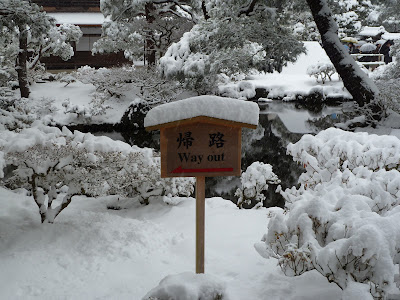
I've been looking for one of those...

I've been looking for one of those...
Wednesday, December 15, 2010
Heating
Japanese houses don't have central heating. They use space heaters. Old Japanese houses had a square fire hole recessed in the floor. I kind of wish we had a fire place.
The problem with kerosene space heaters is that you can only use them when you are home. When you get home from work, it will be the same temperature as it is outside. You can't really run them while you sleep, so when you wake up it might be just above freezing in your apartment. At least, that's the coldest it has gotten so far.
I'm asleep in my bed and I'm slightly worried about the pipes freezing. This is an adjustment.
I'd never have expected a cultural adjustment to come from the way I heat my house. It isn't a big adjustment, it is just one of the unexpected things that you don't think about when you move to a foreign country. And the fact that the amount we spend on kerosene at the gas station is so much cheaper than what we would spend on natural gas in the US is nice.
The problem with kerosene space heaters is that you can only use them when you are home. When you get home from work, it will be the same temperature as it is outside. You can't really run them while you sleep, so when you wake up it might be just above freezing in your apartment. At least, that's the coldest it has gotten so far.
I'm asleep in my bed and I'm slightly worried about the pipes freezing. This is an adjustment.
I'd never have expected a cultural adjustment to come from the way I heat my house. It isn't a big adjustment, it is just one of the unexpected things that you don't think about when you move to a foreign country. And the fact that the amount we spend on kerosene at the gas station is so much cheaper than what we would spend on natural gas in the US is nice.
Saturday, December 4, 2010
Onomatopoeia
Onomatopoeia are words that sound like sounds. You would think that they would translate well from language to language. If that's the case, try taking the test below. Translate the sounds into the English equivalents. I'll do the first one. To see the answers, highlight the text.
pushin - snap
tonton - knock knock
buu - beep
gon gon - ding dong
fura fura - wobble wobble
chirin chirin - ting a ling
gohon gohon - cough cough
hikku - hic
musha musha - munch munch
kan - crack
pon pon - pop pop
riin - ring
kashan - crash
kii - squeak
pashaa - splash
gagagaga - rat-tat-tat
pachi pachi - clap clap
goku goku - gulp gulp
How many did you get right? Isn't it interesting? If I can find a list of animal sounds, I'll do those as well.
pushin - snap
tonton - knock knock
buu - beep
gon gon - ding dong
fura fura - wobble wobble
chirin chirin - ting a ling
gohon gohon - cough cough
hikku - hic
musha musha - munch munch
kan - crack
pon pon - pop pop
riin - ring
kashan - crash
kii - squeak
pashaa - splash
gagagaga - rat-tat-tat
pachi pachi - clap clap
goku goku - gulp gulp
How many did you get right? Isn't it interesting? If I can find a list of animal sounds, I'll do those as well.
Thursday, November 25, 2010
Blog Apathy
I know I haven't been updating much. I've got a bad case of blog apathy. I usually don't have a lot of free time, so when I do have some down time blogging is usually far from my mind. I'll try to keep updating the blog, but don't expect it to be every week. Sorry.
On an interesting note, last weekend we went to Aomori City. At the city museum they had an exhibit from Ghibli Studios. It's a famous animation studio, started by Hayao Miyazaki. He is a little bit like the Walt Disney of Japan, but I think I prefer his movies to Disney's. They are aimed at a little bit older audience. If you can find My Neighbor Totoro, Porco Rosso, or Kiki's Delivery Service I would suggest watching them. Those three are a good starting point.
Anyway, we went to see the museum exhibit. All it was was framed story-boards from his movies. He writes and directs the movies. He also draws the first draft of the art for each scene with animation notes.
For me, it was one of the memorable experiences here. Great animation isn't magic; it starts with a person who has an idea, paper, and colored pencils. Out of such simple materials comes the vision for great stories. Seeing it all effected me enough that I've been picking up a pencil and drawing. There is joy in creating. Sometimes I forget that. Imagining and creating something outside yourself can create a lot of joy and well being within yourself. Maybe now I'll start finding some creative hobbies. I hope you have some too.
On an interesting note, last weekend we went to Aomori City. At the city museum they had an exhibit from Ghibli Studios. It's a famous animation studio, started by Hayao Miyazaki. He is a little bit like the Walt Disney of Japan, but I think I prefer his movies to Disney's. They are aimed at a little bit older audience. If you can find My Neighbor Totoro, Porco Rosso, or Kiki's Delivery Service I would suggest watching them. Those three are a good starting point.
Anyway, we went to see the museum exhibit. All it was was framed story-boards from his movies. He writes and directs the movies. He also draws the first draft of the art for each scene with animation notes.
For me, it was one of the memorable experiences here. Great animation isn't magic; it starts with a person who has an idea, paper, and colored pencils. Out of such simple materials comes the vision for great stories. Seeing it all effected me enough that I've been picking up a pencil and drawing. There is joy in creating. Sometimes I forget that. Imagining and creating something outside yourself can create a lot of joy and well being within yourself. Maybe now I'll start finding some creative hobbies. I hope you have some too.
Tuesday, November 16, 2010
Convenient Stores
Imagine convenient stores being separate from gas stations. How often would you go in?
I'd say just about never, unless you lived next door to one. Maybe that is why there are so many in Japan. If there is always nearby you are prone to go.
Japanese convenient stores have one huge plus. I really hope American convenient stores and utilities get organized and do this to. Here, you can pay all of your utility bills at any convenient store. Only our cell-phones require another method of payment. It really is nice to pay bills in cash. When all the bills come, I just grab my cash, walk to Sankus (the Japanese approximation of "thanks") and pay my bills. The cashier scans the bar codes. I hand him the money. He stamps each bill, tears the receipt stub off of each one, and away I go.
It is strange getting gas and not being able to run in and grab some honey roasted peanuts and a fountain drink, neither of which are worth making a stop for, especially when they don't have fountain drinks. The convenient store prices for bottled drinks are about 50 cents higher than from vending machines, which are often just outside. Vending machines are so ubiquitous I'm not sure why you would by a drink in a convenient store.
On my daily fifteen minute walk to school I pass 8 vending machines that I can think of off the top of my head. No, make that ten. There everywhere and in random places. Driving through the countryside, there might be vending machines where two county roads intersect. Walking through backstreets, there might be vending machines at the end of a dead-end alley.
Now if I could only pay my bills at the vending machine behind my apartment, I'd be set.
I'd say just about never, unless you lived next door to one. Maybe that is why there are so many in Japan. If there is always nearby you are prone to go.
Japanese convenient stores have one huge plus. I really hope American convenient stores and utilities get organized and do this to. Here, you can pay all of your utility bills at any convenient store. Only our cell-phones require another method of payment. It really is nice to pay bills in cash. When all the bills come, I just grab my cash, walk to Sankus (the Japanese approximation of "thanks") and pay my bills. The cashier scans the bar codes. I hand him the money. He stamps each bill, tears the receipt stub off of each one, and away I go.
It is strange getting gas and not being able to run in and grab some honey roasted peanuts and a fountain drink, neither of which are worth making a stop for, especially when they don't have fountain drinks. The convenient store prices for bottled drinks are about 50 cents higher than from vending machines, which are often just outside. Vending machines are so ubiquitous I'm not sure why you would by a drink in a convenient store.
On my daily fifteen minute walk to school I pass 8 vending machines that I can think of off the top of my head. No, make that ten. There everywhere and in random places. Driving through the countryside, there might be vending machines where two county roads intersect. Walking through backstreets, there might be vending machines at the end of a dead-end alley.
Now if I could only pay my bills at the vending machine behind my apartment, I'd be set.
Sunday, November 7, 2010
Gas
One thing that you take for granted when you are around your native language is gas pumps. Next time you buy gas, imagine not understanding any of the words on the pump.
Here, the gas stations vary. Many are full service. Simply tell them how much gas you want in liters or yen, and they'll pump it for you. They also wipe your windows and give you a damp rag to wipe the interior of your car while the gas pumps.
Other stations are self serve. Some of them are pay-at-the-pump and some require that you go in the office and pay. One thing that is interesting about Japan: convenient stores are separate from gas stations. I have no idea how there can be a convenient store on every corner, except that they are more convenient than American convenient stores (more on that another day).
When you first visit a gas station, you have no idea what type it will be. Inevitably, whichever type you think it is, you'll be wrong. You'll think it is self serve because none of the staff are outside, you'll hop out of your car, and then be ushered back in when an attendant rushes out.
Or, as happened to me earlier this week. You'll think it is a pre-pay and try to put cash into the receipt slot. The self-serve stations all have touch-screen pumps. I know the symbol for cash, and I can read the katakana writing for credit card. When you select the cash option, then it lists options for how much you want to pay. I selected 5,000 yen, knowing I would get some change back. I hit the button and tried to slide my cash in the slot. It didn't work. I was confused. I tried again. An attendant hurried over and explained that you pay afterward. I'm sure it made that girls day. Over dinner with her family she got to tell them about the dumb foreigner who tried to shove fifty bucks in the receipt slot.
I wish I could tell you that was the only idiotic thing I've done trying to get gas, but it isn't. Just two weeks ago I was at a pre-pay self-serve. I told it I wanted to put in 2000 yen worth. I put the green nozzle in my car and...nothing happened. How annoying. I hit cancel, got my change and tried again. Same thing. Just as I was starting to get frustrated, ready to get my change and leave, an attendant came over and pointed out that I had the wrong nozzle. Thank goodness there is always someone around to witness me acting like a moron.
In retrospect, maybe the problem isn't with the language barrier or the gas pumps...
Here, the gas stations vary. Many are full service. Simply tell them how much gas you want in liters or yen, and they'll pump it for you. They also wipe your windows and give you a damp rag to wipe the interior of your car while the gas pumps.
Other stations are self serve. Some of them are pay-at-the-pump and some require that you go in the office and pay. One thing that is interesting about Japan: convenient stores are separate from gas stations. I have no idea how there can be a convenient store on every corner, except that they are more convenient than American convenient stores (more on that another day).
When you first visit a gas station, you have no idea what type it will be. Inevitably, whichever type you think it is, you'll be wrong. You'll think it is self serve because none of the staff are outside, you'll hop out of your car, and then be ushered back in when an attendant rushes out.
Or, as happened to me earlier this week. You'll think it is a pre-pay and try to put cash into the receipt slot. The self-serve stations all have touch-screen pumps. I know the symbol for cash, and I can read the katakana writing for credit card. When you select the cash option, then it lists options for how much you want to pay. I selected 5,000 yen, knowing I would get some change back. I hit the button and tried to slide my cash in the slot. It didn't work. I was confused. I tried again. An attendant hurried over and explained that you pay afterward. I'm sure it made that girls day. Over dinner with her family she got to tell them about the dumb foreigner who tried to shove fifty bucks in the receipt slot.
I wish I could tell you that was the only idiotic thing I've done trying to get gas, but it isn't. Just two weeks ago I was at a pre-pay self-serve. I told it I wanted to put in 2000 yen worth. I put the green nozzle in my car and...nothing happened. How annoying. I hit cancel, got my change and tried again. Same thing. Just as I was starting to get frustrated, ready to get my change and leave, an attendant came over and pointed out that I had the wrong nozzle. Thank goodness there is always someone around to witness me acting like a moron.
In retrospect, maybe the problem isn't with the language barrier or the gas pumps...
Saturday, November 6, 2010
Census
I'm sure people think we're crazy for moving to a country where we don't speak the language. I'd reassure those people that for the most part you can adjust to daily life. It's the special events you have to watch out for.
Have you ever wondered what a Japanese census form looks like?

Those are the directions. If we hadn't had our Japanese tutor, I don't know what we would've done. I was able to figure out one question on the whole census (which made me very proud, by the way). The rest I stared at in wide-eyed disbelief. I'm pretty sure filling in random bubbles would've been a bad idea on an official census, but without help, that's all we could have done.
One of the small things that is was a pleasant surprise was seeing the envelope.

Vertical writing seems so cool. It is amusingly foreign, at least until you try to read a book. It is really hard to keep track of what line you are on.
Have you ever wondered what a Japanese census form looks like?

Those are the directions. If we hadn't had our Japanese tutor, I don't know what we would've done. I was able to figure out one question on the whole census (which made me very proud, by the way). The rest I stared at in wide-eyed disbelief. I'm pretty sure filling in random bubbles would've been a bad idea on an official census, but without help, that's all we could have done.
One of the small things that is was a pleasant surprise was seeing the envelope.

Vertical writing seems so cool. It is amusingly foreign, at least until you try to read a book. It is really hard to keep track of what line you are on.
Monday, November 1, 2010
Weddings
Last week I talked with a teacher who is getting married soon. It reminded me that Japanese weddings are different from western weddings in one specific way.
American style ceremonies are very popular here. Unlike in American weddings, it isn't traditional for guests to bring a gift. No, here guests are charged to go to the wedding, usually around $300. Around half of that price is returned to them in the form of a gift from the bride and groom.
I think it is an interesting custom. It pays for the wedding, and provides money for the new couple, and--hopefully-- the guests feel appreciated. It also cuts down on people who barely know you trying to shoehorn themselves in on the guest list.
American style ceremonies are very popular here. Unlike in American weddings, it isn't traditional for guests to bring a gift. No, here guests are charged to go to the wedding, usually around $300. Around half of that price is returned to them in the form of a gift from the bride and groom.
I think it is an interesting custom. It pays for the wedding, and provides money for the new couple, and--hopefully-- the guests feel appreciated. It also cuts down on people who barely know you trying to shoehorn themselves in on the guest list.
Wednesday, October 27, 2010
Ramen
The weather turned cold and windy this week. It'll be in the forties tomorrow. Tonight after taiko practice we stopped for ramen. Miso ramen is delicious. Boiling hot soup and gyoza are a warm happy thought.
Hot soup on a cold day is always comforting. Luckily we picked a country that loves soup. And they serve soup in bowls large enough to bath a German shepherd in. Seriously, how do Japanese people stay so thin when they can eat so much? I'm pretty sure one bowl of ramen could feed at least three people. But, when in Rome do as the Romans do, so I try to eat it all. I fail miserably. One stomach can't hold that much.
Oh well. At least we can have delicious ramen whenever we want. Mmmmm.
Hot soup on a cold day is always comforting. Luckily we picked a country that loves soup. And they serve soup in bowls large enough to bath a German shepherd in. Seriously, how do Japanese people stay so thin when they can eat so much? I'm pretty sure one bowl of ramen could feed at least three people. But, when in Rome do as the Romans do, so I try to eat it all. I fail miserably. One stomach can't hold that much.
Oh well. At least we can have delicious ramen whenever we want. Mmmmm.
Thursday, October 21, 2010
Fall Colors
Sorry I've been slacking.
Why don't you kick back and enjoy some photos of the fall colors. We drove into the mountains with a friend to celebrate having been here for six months. Japanese mountain roads are something else. They often choke down to one lane with traffic trying to go both ways. As if that wasn't stressful enough, huge tour buses also use the mountain roads. For some reason last Sunday there was a lot of traffic. It wasn't a nice relaxing drive, but it was worth it to see the colors in the Japanese mountains.


And last but not least, you can see where people carved their names in a tree. In Japanese. That was a strange thing to see.

Why don't you kick back and enjoy some photos of the fall colors. We drove into the mountains with a friend to celebrate having been here for six months. Japanese mountain roads are something else. They often choke down to one lane with traffic trying to go both ways. As if that wasn't stressful enough, huge tour buses also use the mountain roads. For some reason last Sunday there was a lot of traffic. It wasn't a nice relaxing drive, but it was worth it to see the colors in the Japanese mountains.


And last but not least, you can see where people carved their names in a tree. In Japanese. That was a strange thing to see.

Friday, October 15, 2010
One Piece
Japanese pop culture was never even on my radar before this year. Sure, I'm a huge nerd, but I had still never been interested in manga, anime, or j-pop. Japanese pop culture would've been on the top ten list of things I didn't care about, right between Olympic curling, and the grand duke of Luxembourg.
It turns out anime is pretty cool. Kelli and I are watching a show called One Piece. It has been running since the '90s. There are nearly 500 episodes. We've watched about 30. It's difficult to describe (a) without making it sound weird and (b) without making me sound weird. Think Pirates of the Caribbean and you'll have a good idea.
We'll start watching Fullmetal Alchemist soon. I'm reading the manga right now and I'm hooked. I wouldn't recommend either show or manga for kids. They both deal with pretty difficult themes and are violent.
Little did I know that moving to Japan would feed my nerdy-ness. I'm picking up whole new genres of nerd obsession. It's always good to try new things.
It turns out anime is pretty cool. Kelli and I are watching a show called One Piece. It has been running since the '90s. There are nearly 500 episodes. We've watched about 30. It's difficult to describe (a) without making it sound weird and (b) without making me sound weird. Think Pirates of the Caribbean and you'll have a good idea.
We'll start watching Fullmetal Alchemist soon. I'm reading the manga right now and I'm hooked. I wouldn't recommend either show or manga for kids. They both deal with pretty difficult themes and are violent.
Little did I know that moving to Japan would feed my nerdy-ness. I'm picking up whole new genres of nerd obsession. It's always good to try new things.
Sunday, October 10, 2010
Dragonflies! It works!
So, the brown dragonflies can be hypnotized and picked up! I'll post some pictures later today. Also, it seems that it really is only the brown ones that will fall for it. The red ones (the only other color available yesterday) would take off as soon as they saw you coming.
Speaking of seeing you coming, walking around waving your finger in a circle isn't exactly a good way to blend in. My first attempt at dragonfly bamboozlement was next to the road. I walked toward the dragonfly resting on the fence slowly, with my finger moving in big, slow circles. I got within a foot before it took off. At about that time I heard a car go by behind me. From a car, no one would be able to see a dragonfly. All they would see is a big, white foreigner hunkered down, creeping towards a fence waving his finger in a circle. Had a red dragonfly landed on my face at about that time, it would've been very well camouflaged. I'm not sure why they let me go out in public.
Especially because after we went to the park and made some dragonflies dizzy, we took pictures of spiders by the road. We could get really close to them and get some good pictures. On the other hand, they were very active and made us jumpy. A couple of foreigners crouching down, taking pictures of who-knows-what and getting startled had to make for a head-scratcher.
We also saw a snake eat a frog. It was a pretty eventful day.
Speaking of seeing you coming, walking around waving your finger in a circle isn't exactly a good way to blend in. My first attempt at dragonfly bamboozlement was next to the road. I walked toward the dragonfly resting on the fence slowly, with my finger moving in big, slow circles. I got within a foot before it took off. At about that time I heard a car go by behind me. From a car, no one would be able to see a dragonfly. All they would see is a big, white foreigner hunkered down, creeping towards a fence waving his finger in a circle. Had a red dragonfly landed on my face at about that time, it would've been very well camouflaged. I'm not sure why they let me go out in public.
Especially because after we went to the park and made some dragonflies dizzy, we took pictures of spiders by the road. We could get really close to them and get some good pictures. On the other hand, they were very active and made us jumpy. A couple of foreigners crouching down, taking pictures of who-knows-what and getting startled had to make for a head-scratcher.
We also saw a snake eat a frog. It was a pretty eventful day.
Monday, October 4, 2010
Six months
Today marks the completion of six months here in Japan. It's been a wild ride.
I've learned a brain-ton (2,000 know-pounds to the brain ton, for those of you who aren't aquainted with units of knowledge). I've learned about being a teacher. I've learned about being a husband. I've learned some Japanese. I've learned how to drive on the opposite side of the road.
The pressures and difficulties of living abroad either temper you or break you, I think. Thankfully, I feel like I'm being tempered (he-he-he. Wheeee. Wahoo...Oh, maybe I snapped).
If someone asked me to recommend living abroad, my recommendation would take the form of a TV commercial for a prescription drug. It would open with beautiful scenes of rice fields, and cherry blossoms. Scenes of castles, zen gardens, and temples would play in the background while the narrator speaks.
"Do you suffer from mundania? Is the humdrum of daily life getting you down? Then maybe Living Abroad is right for you. Living Abroad will awaken that dormant sense of wonder. Living Abroad will infuse life with new energy. If you've been longing for something new, Living Abroad might be what you need. Ask your doctor about Living Abroad. Probable side effects include frustration, loneliness, isolation, confusion, stress induced premature baldness, discombobulation, bewilderment, indigestion, diarrhea, and/or constipation."
So, if your thinking about living abroad, 3 out of 4 gaijin (foreigners) recommend it.
I've learned a brain-ton (2,000 know-pounds to the brain ton, for those of you who aren't aquainted with units of knowledge). I've learned about being a teacher. I've learned about being a husband. I've learned some Japanese. I've learned how to drive on the opposite side of the road.
The pressures and difficulties of living abroad either temper you or break you, I think. Thankfully, I feel like I'm being tempered (he-he-he. Wheeee. Wahoo...Oh, maybe I snapped).
If someone asked me to recommend living abroad, my recommendation would take the form of a TV commercial for a prescription drug. It would open with beautiful scenes of rice fields, and cherry blossoms. Scenes of castles, zen gardens, and temples would play in the background while the narrator speaks.
"Do you suffer from mundania? Is the humdrum of daily life getting you down? Then maybe Living Abroad is right for you. Living Abroad will awaken that dormant sense of wonder. Living Abroad will infuse life with new energy. If you've been longing for something new, Living Abroad might be what you need. Ask your doctor about Living Abroad. Probable side effects include frustration, loneliness, isolation, confusion, stress induced premature baldness, discombobulation, bewilderment, indigestion, diarrhea, and/or constipation."
So, if your thinking about living abroad, 3 out of 4 gaijin (foreigners) recommend it.
Thursday, September 30, 2010
Hypnotizing Dragonflies
A student of mine told me that you can hypnotize dragonflies. That is a succinct summary of a much longer conversation.
Join me on a wild trip down Tangent Lane, where I'll distract us from the main topic for a few minutes to --hopefully-- entertain both of us. If not, at least I'll be amused.
Living in a foreign country can be very fun. Conversations are like a wild mix of Taboo, charades, and blank staring. Speaking with Japanese people usually involves partial sentences and gesturing. For some reason I never have my dictionary on me, so life is much more complicated. There is a complex ratio that describes whether a conversation is fun or hair-pulling stressful.
[time available + (difficulty of concepts - vocabulary)] X immediacy ^ importance = amusement level
And that equation is scientifically tested. I pulled it out of a research paper titled "Living in a Foreign Country: Sanity's Breaking Point." It has many other fine equations such as the function to calculate the rate at which patience is exhausted based on the number, volume, and proximity of advertising kiosks in a department store. One thrift store has so many loud kiosks all near each other playing different music so loud it obliterates the minds ability to focus. Only theoretical physics has numbers small enough to describe how fast patience was exhausted.
Anyway, back to my original tangent.
Conversations such as "You can hypnotize dragonflies," over the course of fifteen minutes are quite fun. On the other side of things, you have the "You've been pulled over for a reason you can't understand and the policeman wants information from you that you can't provide and it is 10:30 at night and you still have a commute to deal with," conversation which is not fun at all.
So, to summarize fifteen minutes of partial sentences, gestures, laughs, and astonishment, you can hypnotize dragonflies. You wave your finger in a circle in front of their face. We're not sure exactly why it works, but the theory is that because they have so many eyes, trying to follow your finger makes them dizzy. Once they are good and dizzy, they will step onto your finger (or land on it if you are such a skilled dragonfly charmer that you can bamboozle them in mid-flight). They will sit there quite contentedly for several seconds before they fly away. Oh yeah, and it only works with the brown ones.
I can't wait to try it. I found out about this right before the weather got too hot. All the brown dragonflies disappeared and only the black and yellow striped ones were still around. Now the brown ones are everywhere. If I get a chance to catch a dragonfly I'll definitely let you know.
I know all of you will try too. I'm picturing all of you crouched down wiggling your fingers at something and the image has me laughing out loud.
Join me on a wild trip down Tangent Lane, where I'll distract us from the main topic for a few minutes to --hopefully-- entertain both of us. If not, at least I'll be amused.
Living in a foreign country can be very fun. Conversations are like a wild mix of Taboo, charades, and blank staring. Speaking with Japanese people usually involves partial sentences and gesturing. For some reason I never have my dictionary on me, so life is much more complicated. There is a complex ratio that describes whether a conversation is fun or hair-pulling stressful.
[time available + (difficulty of concepts - vocabulary)] X immediacy ^ importance = amusement level
And that equation is scientifically tested. I pulled it out of a research paper titled "Living in a Foreign Country: Sanity's Breaking Point." It has many other fine equations such as the function to calculate the rate at which patience is exhausted based on the number, volume, and proximity of advertising kiosks in a department store. One thrift store has so many loud kiosks all near each other playing different music so loud it obliterates the minds ability to focus. Only theoretical physics has numbers small enough to describe how fast patience was exhausted.
Anyway, back to my original tangent.
Conversations such as "You can hypnotize dragonflies," over the course of fifteen minutes are quite fun. On the other side of things, you have the "You've been pulled over for a reason you can't understand and the policeman wants information from you that you can't provide and it is 10:30 at night and you still have a commute to deal with," conversation which is not fun at all.
So, to summarize fifteen minutes of partial sentences, gestures, laughs, and astonishment, you can hypnotize dragonflies. You wave your finger in a circle in front of their face. We're not sure exactly why it works, but the theory is that because they have so many eyes, trying to follow your finger makes them dizzy. Once they are good and dizzy, they will step onto your finger (or land on it if you are such a skilled dragonfly charmer that you can bamboozle them in mid-flight). They will sit there quite contentedly for several seconds before they fly away. Oh yeah, and it only works with the brown ones.
I can't wait to try it. I found out about this right before the weather got too hot. All the brown dragonflies disappeared and only the black and yellow striped ones were still around. Now the brown ones are everywhere. If I get a chance to catch a dragonfly I'll definitely let you know.
I know all of you will try too. I'm picturing all of you crouched down wiggling your fingers at something and the image has me laughing out loud.
Wednesday, September 29, 2010
Religion
One major difference living here is the number of churches. They're almost as rare as Shinto shrines in southern Louisiana. Whenever you see one it is surprising enough to point out.
Religion doesn't come up often in conversation or in the news. Today I was pretty surprised to see a story about Christianity on the main page of Japan today. It's a pretty cool story.
Religion doesn't come up often in conversation or in the news. Today I was pretty surprised to see a story about Christianity on the main page of Japan today. It's a pretty cool story.
Subscribe to:
Posts (Atom)